Showing posts with label poptech. Show all posts

Thursday, October 30, 2008

Dr. Stephen Badylak - Regenerative Tissues

Dr. Stephen Badylak is an expert on tissue engineering and regenerative medicine, with over 40 U.S. patents and 200 patents worldwide.


This was by far one of the most exciting presentations at PopTech.

Here's the video:


Dr. Badylak has studied how or body can regenerate its own tissue by rallying the stem cells we have in our own body. He discovered an extracellular matrix that is loaded with information and acts like a scaffolding.
(picture of extracellular matrix)

When you apply this material to a wound, the stem cells in our bone marrow rush to the area and start rebuilding tissue. His tests have re-grown cut off fingers, wounds in bladders, closed a softball size hole in a horse's nose...This stuff regenerates skin, hair, tissue, even muscle. He's using it to help generate tissue by Iraq veterans who have lost limbs, muscles, etc.

You can find out more about his research via an Esquire article,

Jay Parkinson - Social Network to Connect you to your Doctor


Jay Parkinson has created HelloHealth which lets you make appointments online, email your doctor, and use 21st century tools to manage your health. I think it's a great model.


The phrase that stuck with me after his presentation at Pop!Tech?

16.9% of the US GDP runs on handwritten notes.

Monday, October 27, 2008

Clay Shirky - Design for Generosity

I've followed Clay Shirky for awhile now (he's the author of Here Comes Everybody: The Power of Organizing Without Organizations), and it was great to hear him speak at PopTech.

He admitted that he hasn't found the magic formula for explaining the growth & activity in social media sites to "old school" organizations. I find myself in that role again and again, and while I'm getting better at changing mindsets, I haven't found the magic formula either.

His top level elements of a social community design that will encourage charity?
1. Designing for intrinsic motivation (letting members be recognized for things they are good at doing, make them feel like they are doing the right thing, ensure that their efforts are appreciated).
2. Make sure members have autonomy
3. Make sure to strike a balance between a community that is too open or too closed/regulated - neither extremes will be successful.

I think they are great qualities to keep in mind when trying to encourage use of a new social network. Now I just need to quantify the tactics required for educating an old school organization on why and how to get involved in social media. If I figure out how to educate them so that they "get" it on a gut level, I'll let you know.

Friday, October 24, 2008

PopTech Day 1- Scents, Passion, Energy, Expression and Addiction

As usual the first day of Pop!Tech was amazing. The speakers that spoke to me were:

Saul Griffith


He has calculated his entire energy usage for his lifetime - including the energy used to create the things he purchases like bottled water, his laptop, and the NY Times that gets delivered to his front door every morning. You can calculate your energy usage too at Wattzon.com. He provided a summary about our global energy usage and how it will impact our environment.

His analysis shows that we need to product more energy fast over the next 25 years (akin to one solar panel a second...and he outlines how fast we need to produce other types of energy production). We also need to reduce our energy usage so that those in the developing world who currently don't have access to electricity.

So his plan to reduce his energy footprint? Massive reduction in travel (Pop!Tech had to work hard to get him to fly to Maine to speak), eliminating his bottle of water per day, becoming a vegetarian, etc. It certainly made me think about reducing my purchases of bottled drinks.

He also advocated for companies to develop products to last longer. I couldn't agree more. Considering I grew up in Maine with a family that made things last, bought things second hand, etc. I can't agree more that we should move away from our disposable culture, learn how to mend clothing, and focus on reducing our "stuff" and keeping our "stuff" longer.

Malcom Gladwell

Malcom is always interesting to listen to. In his presentation, he's taken on the idea that some talents are genetically determined (like the myth that Kenyans are better at running) and has instead looked at the data and discovered that it has everything to do with how young people's talent is nurtured. For instance, boys in Kenyan run 5 to 10 miles per day. Compare that to how inactive American boys are, and you can see why our athletes might not be as good at long distant running. So there isn't a scarcity in talent, we just are not preparing our youth effectively to capitalize on their talents.

Peter Wybrow

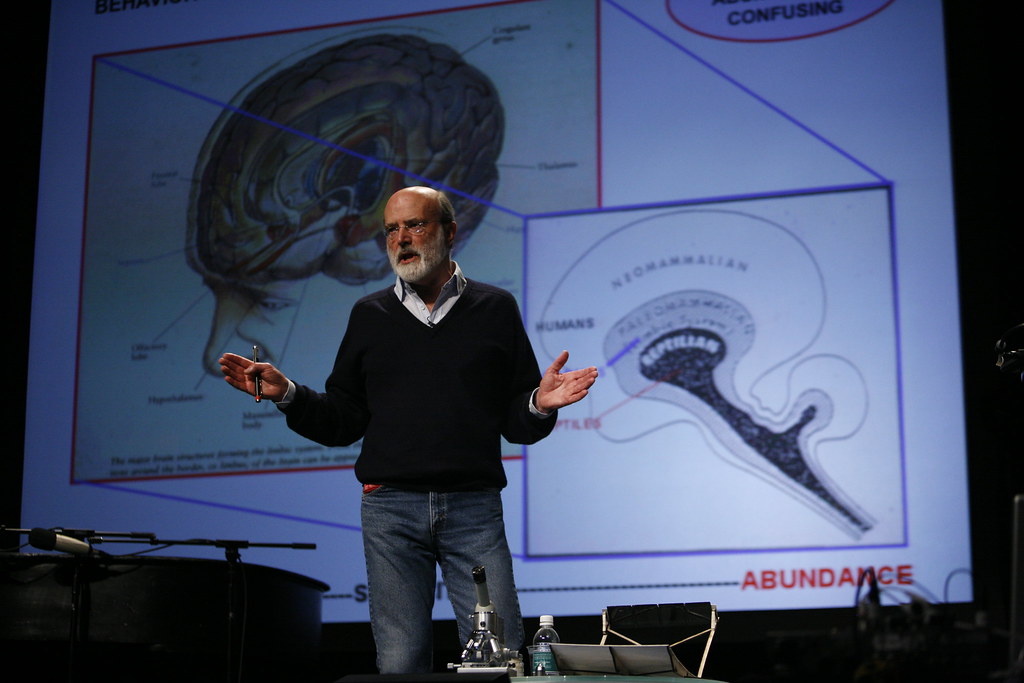
Peter has written a book about what happens to people when we live in a society of abundance and explored the addictive cycle of living with abundance from a physiological perspective. He highlighted the elements that drive humans engagement in our economy: self interest, curiosity, a competition for resources, and social ambition. I can't help but wonder how we balance our innate curiosity-- exploring new ideas and things-- with our need to keep products for 10 years to sustain our ecological health.

Our 24/7, always-on economy surrounds us with stress and a sense of urgency, and creates an environment of low face-to-face people interaction, and it fuels our addiction. It turns otu Starbucks is a part of the vicious cycle. On one slide Peter mentions that Starbucks coffee has 8 times the caffeine in an average cup of coffee. Isn't that crazy? I had always wondered why their coffee made me more jittery.

I was very aware of the negative impacts of this type of life style. Last year's Poptech speaker who talked about the slow movement really helped me re-focus on trying to get more sleep, and increase the amount of face-to-face interaction I had with other people. Studies show that sleep deprivation makes you gain weight because it decreases your ability to control your cravings for high caloric foods. So while Peter didn't provide a 12 step program for breaking the cycle of addiction like I would have hoped, I was re-energized to sleep more, keep up the exercise, increase my face-to-face time with people, and attempt to make my life more simple and less consumer driven. Less stuff, more quality experiences. My family's commitment to having experiences together around Christmas instead of buying each other stuff has always felt "right" but now makes even more sense to me.

One of the themes emerging from Pop!Tech this year, and re-iterated during Peter's presentation was a historical look at the impact that scarcity has on human behavior. In Peter's presentation he looked at the Renaissance - a period of great poverty but also a period of great creativity and innovation. Considering our current economic climate, and considering I'm an optimist, I think I'm going to focus on how scarcity will bring unknown great art and technological innovation.

Tuesday, October 21, 2008

It's Almost Time for Pop!Tech

Oh...I can't wait, and Pop!Tech has posted an intro video about Pop!Tech to get me excited about this year's conference. I can't wait to get re-inspired and get my passion for social change and the potential for technology re-charged.

Tuesday, April 29, 2008

A type of Dancing You've Never Seen Before

Here's a video of a dancer that I met at Pop!Tech who needs crutches to walk and has developed a really cool inspirational dance form.

Thursday, October 18, 2007

PopTech: Day One

Ok. It's officially day two. PopTech started last night with a cocktail hour at the Waterfront. It was a great way to catch up with old friends, and have some great new conversations about how to support non-profit capacity by more effectively engaging volunteers.

The show has started off with Chris Jordan talking about his photographs of our trash, his "Intolerable Beauty" series - his photos of how much materials we discard are awe inspiring. I has just seen him on the Colbert report last week.

Tuesday, September 18, 2007

Stumbling Upon Happiness

Now that the speakers for PopTech are posted, I'm busy reading to catch myself up to speed on the variety of topics that will be covered during the October conference.

The first book I consumed, Stumbling Upon Happiness, was a quick read for me and it discussed how our brains store memories, and use those memories ineffectively to predict our future happiness.

Considering I'm in a transitional phase with my work situation, this book was perfect for me to read and process. I still haven't fully embodied all of the research presented, and I can't wait to meet the author to fully understand his thesis.

My one funny take away - our future prediction of happiness is based on our recent memories and our current state of mind. In particular, our happiness related to food is based on how often we consume our favorite food.

For example, if I have sushi one day and it's fabulous, it won't be as exciting the next day. But if only have sushi once a month, I will always experience the same level of happiness because my memory of how great it was has faded. So instead of forcing myself to "try something new off the menu" at a restaurant I only go to once a month, I should let myself eat my favorite dish, because I will get more happiness overall.

Next on the reading list is The Female Brain.