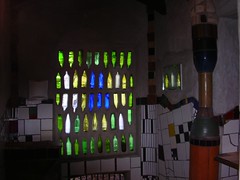
Really. The word that describes the fear of long words is: Hippopotomonstrosequippedalio.
Look it up.
Thursday, January 08, 2009


Thursday, October 30, 2008
Dr. Stephen Badylak - Regenerative Tissues
Dr. Stephen Badylak is an expert on tissue engineering and regenerative medicine, with over 40 U.S. patents and 200 patents worldwide.

This was by far one of the most exciting presentations at PopTech.
Here's the video:
When you apply this material to a wound, the stem cells in our bone marrow rush to the area and start rebuilding tissue. His tests have re-grown cut off fingers, wounds in bladders, closed a softball size hole in a horse's nose...This stuff regenerates skin, hair, tissue, even muscle. He's using it to help generate tissue by Iraq veterans who have lost limbs, muscles, etc.
You can find out more about his research via an Esquire article,
This was by far one of the most exciting presentations at PopTech.
Here's the video:
Dr. Badylak has studied how or body can regenerate its own tissue by rallying the stem cells we have in our own body. He discovered an extracellular matrix that is loaded with information and acts like a scaffolding.
(picture of extracellular matrix)
When you apply this material to a wound, the stem cells in our bone marrow rush to the area and start rebuilding tissue. His tests have re-grown cut off fingers, wounds in bladders, closed a softball size hole in a horse's nose...This stuff regenerates skin, hair, tissue, even muscle. He's using it to help generate tissue by Iraq veterans who have lost limbs, muscles, etc.
You can find out more about his research via an Esquire article,
Jay Parkinson - Social Network to Connect you to your Doctor

Jay Parkinson has created HelloHealth which lets you make appointments online, email your doctor, and use 21st century tools to manage your health. I think it's a great model.
The phrase that stuck with me after his presentation at Pop!Tech?
16.9% of the US GDP runs on handwritten notes.
Gary Slutkin - Violence as an Infectious Disease
This presentation at Pop!Tech was fascinating. Gary Slutkin has a background in infectious diseases and discovered that the spread of violence behaves a lot like the spread of disease. He has applied the formula for containing the spread of infectious diseases to violence reduction in Chicago with great success.
The formula to control infectious diseases looks like this:
The formula to control infectious diseases looks like this:
- Interrupt transmission
- Change the behavior that is driving the transmission (this is based on the social network)
Visualizing your Friend Connections on Facebook
I discovered a neat way to view your friend connections on Facebook via a new (to me) application. You can see my graph here.
Wednesday, October 29, 2008
Finally! Google Maps Helps me Find a Restroom
Women everywhere will appreciate this. We are always aware in our travels of where the free and clean restrooms are, but now you can find them using Google Maps.
SitOrSquat.com

The wonderfully named SitOrSquat.com is a website and mobile application that has mapped over 25,000 public restrooms. In their own words SitOrSquat "is dedicated to telling you where the closest public restroom is and whether or not that restroom is worthy of your bare bottom."
Users can rate the restrooms, view photos, read reviews...you can even create a list of your favorite toilets. Even though this is a US based application, I would flag the restroom that I visited in Eutopia in the Northland and Kawa Kawa's art deco toilets.
It also has a iPhone application. Turns out New York has been documenting restrooms for a bit longer. Here's their map: NYRestroom.com.
SitOrSquat.com
The wonderfully named SitOrSquat.com is a website and mobile application that has mapped over 25,000 public restrooms. In their own words SitOrSquat "is dedicated to telling you where the closest public restroom is and whether or not that restroom is worthy of your bare bottom."
Users can rate the restrooms, view photos, read reviews...you can even create a list of your favorite toilets. Even though this is a US based application, I would flag the restroom that I visited in Eutopia in the Northland and Kawa Kawa's art deco toilets.
It also has a iPhone application. Turns out New York has been documenting restrooms for a bit longer. Here's their map: NYRestroom.com.
Hookup Maps - A Mashup of Craigslist Personals and Google Maps
So it turns out there is a mashup application out there to let you know who is single in your neighborhood. Beyond the obvious (that as a single woman I don't want random men to know where I live before vetting them) it might actually be helpful. I'm thinking of my own neighborhood where there are TONS of townhouses and apartment complexes in a small area. I walk by them on the way to the metro, and think, "I bet the love of my life lives in one of these apartments...how would I ever meet him"?
 (Credit: CNET Networks)
HookupMaps is a mix of Craigslist personal ads and Google Maps - showing you where the people wanting to "hook up" in your city are. I wonder if it pulls from the sexually scarey "random encounters" section, "the LTR section" or some other section. It will not only tell you how many single people there are in your neighborhood, but it will also tell you the age and gender of each poster.
 (Credit: CNET Networks)
The site also lets you filter your searches based on a few criteria: m4m, m4w, w4w, w4m, and whether the post contains a picture. You can search by city, neighborhood, or, by keyword. Here in DC maybe that means you can search for "liberal" or "democrat" or "lawyer" if that's your preference.
There's a different twist on staving off movie watching loneliness that I discovered while at Pop!Tech. It's a blog called "White Hat Stories", where a poster announces that they will be wearing a white hat and watching a movie at X movie theater in case anyone wants to join them for company.
It's interesting to see how people are using technology to encourage face-to-face interactions - like joining groups on Facebook or Meetup.com
Technology use is Stimulating Evolutionary Change
And everyone laughed when Ray Kurzweil talked about the ultimate merging of human brains and machines.
Here's a fascinating article looking at how we strengthen certain neural passageways due to our technology use - making use better at decision-making, data filtering, and complex reasoning, but also limiting our ability to read body language.
The whole article is here.
Here's a fascinating article looking at how we strengthen certain neural passageways due to our technology use - making use better at decision-making, data filtering, and complex reasoning, but also limiting our ability to read body language.
The whole article is here.
Monday, October 27, 2008
Potential for Terrorist Use of Twitter
Fascinating. US Army has posted a report claiming that certain mobile and web technologies (like Twitter) could be used to enable terrorism. The report references how activists used Twitter to organize protests at the Republican National Convention. More here.
Clay Shirky - Design for Generosity
I've followed Clay Shirky for awhile now (he's the author of Here Comes Everybody: The Power of Organizing Without Organizations), and it was great to hear him speak at PopTech.
He admitted that he hasn't found the magic formula for explaining the growth & activity in social media sites to "old school" organizations. I find myself in that role again and again, and while I'm getting better at changing mindsets, I haven't found the magic formula either.
His top level elements of a social community design that will encourage charity?
1. Designing for intrinsic motivation (letting members be recognized for things they are good at doing, make them feel like they are doing the right thing, ensure that their efforts are appreciated).
2. Make sure members have autonomy
3. Make sure to strike a balance between a community that is too open or too closed/regulated - neither extremes will be successful.
I think they are great qualities to keep in mind when trying to encourage use of a new social network. Now I just need to quantify the tactics required for educating an old school organization on why and how to get involved in social media. If I figure out how to educate them so that they "get" it on a gut level, I'll let you know.
He admitted that he hasn't found the magic formula for explaining the growth & activity in social media sites to "old school" organizations. I find myself in that role again and again, and while I'm getting better at changing mindsets, I haven't found the magic formula either.
His top level elements of a social community design that will encourage charity?
1. Designing for intrinsic motivation (letting members be recognized for things they are good at doing, make them feel like they are doing the right thing, ensure that their efforts are appreciated).
2. Make sure members have autonomy
3. Make sure to strike a balance between a community that is too open or too closed/regulated - neither extremes will be successful.
I think they are great qualities to keep in mind when trying to encourage use of a new social network. Now I just need to quantify the tactics required for educating an old school organization on why and how to get involved in social media. If I figure out how to educate them so that they "get" it on a gut level, I'll let you know.
Marian Bantjes - Beautiful Designs

Her designs are beautiful, and one line from her presentation really stuck with me: "When we spend time on something, we sacrifice ourselves to do it."
Sunday, October 26, 2008
Yummy Chocolate -TCHO
I have a confession to make. I've become a chocoholic, and have really been enjoying Trader Joe's single source chocolate ice cream. I've discovered similar high quality chocolate in bar form at PopTech -- www.tcho.com. So yummy!
Saturday, October 25, 2008
Translate your video into another language
Free tool to translate your videos into another language: dotsub.com.
Global Volunteer Service before College
PopTechers were introduced to Global Citizen Year - a nonprofit that is creating a movement to get young people to do a year of global service during the year between high school and college. It will be interesting to see how they create an attitude change amongst high schoolers to fill their ranks of volunteer slots... I also wonder how this will be more successful than the Peace Corps? Are we seeing duplication of efforts?
The Extinction of Languages
David Harrison is a ethnolinguist who is working with the Living Languages Institute and National Geographic to record dying languages around the world. They've created a great site where you can see the last living survivors of various languages (with English translations) at languagehotspots.org.
Friday, October 24, 2008
PopTech Day 1- Scents, Passion, Energy, Expression and Addiction
As usual the first day of Pop!Tech was amazing. The speakers that spoke to me were:
Saul Griffith
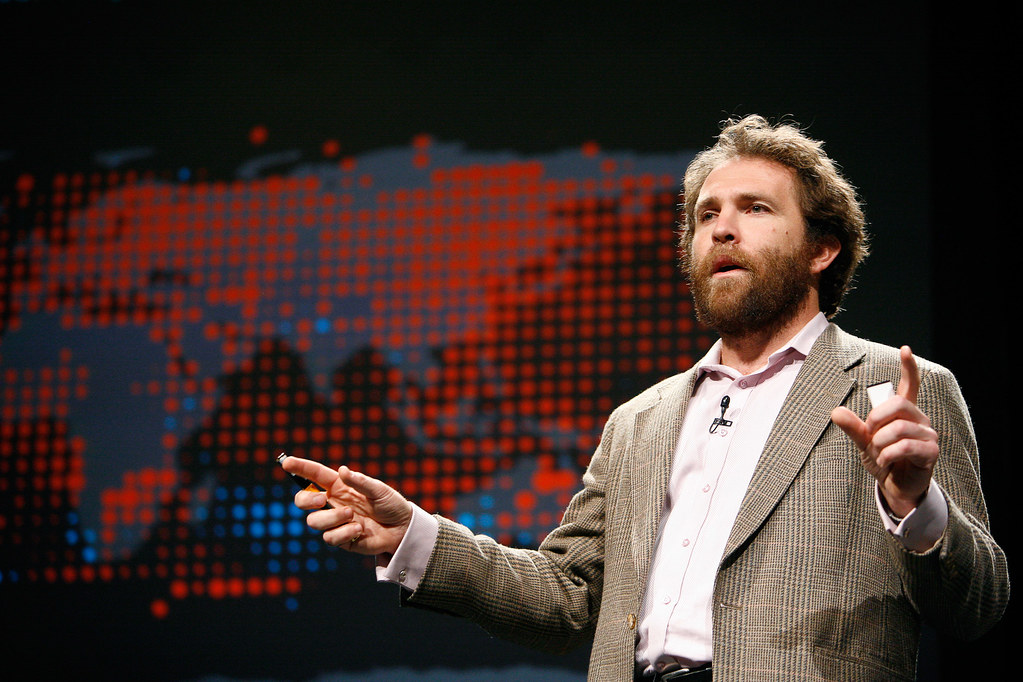
He has calculated his entire energy usage for his lifetime - including the energy used to create the things he purchases like bottled water, his laptop, and the NY Times that gets delivered to his front door every morning. You can calculate your energy usage too at Wattzon.com. He provided a summary about our global energy usage and how it will impact our environment.
Saul Griffith
He has calculated his entire energy usage for his lifetime - including the energy used to create the things he purchases like bottled water, his laptop, and the NY Times that gets delivered to his front door every morning. You can calculate your energy usage too at Wattzon.com. He provided a summary about our global energy usage and how it will impact our environment.
His analysis shows that we need to product more energy fast over the next 25 years (akin to one solar panel a second...and he outlines how fast we need to produce other types of energy production). We also need to reduce our energy usage so that those in the developing world who currently don't have access to electricity.
So his plan to reduce his energy footprint? Massive reduction in travel (Pop!Tech had to work hard to get him to fly to Maine to speak), eliminating his bottle of water per day, becoming a vegetarian, etc. It certainly made me think about reducing my purchases of bottled drinks.
He also advocated for companies to develop products to last longer. I couldn't agree more. Considering I grew up in Maine with a family that made things last, bought things second hand, etc. I can't agree more that we should move away from our disposable culture, learn how to mend clothing, and focus on reducing our "stuff" and keeping our "stuff" longer.
Malcom Gladwell

Malcom is always interesting to listen to. In his presentation, he's taken on the idea that some talents are genetically determined (like the myth that Kenyans are better at running) and has instead looked at the data and discovered that it has everything to do with how young people's talent is nurtured. For instance, boys in Kenyan run 5 to 10 miles per day. Compare that to how inactive American boys are, and you can see why our athletes might not be as good at long distant running. So there isn't a scarcity in talent, we just are not preparing our youth effectively to capitalize on their talents.
Peter Wybrow
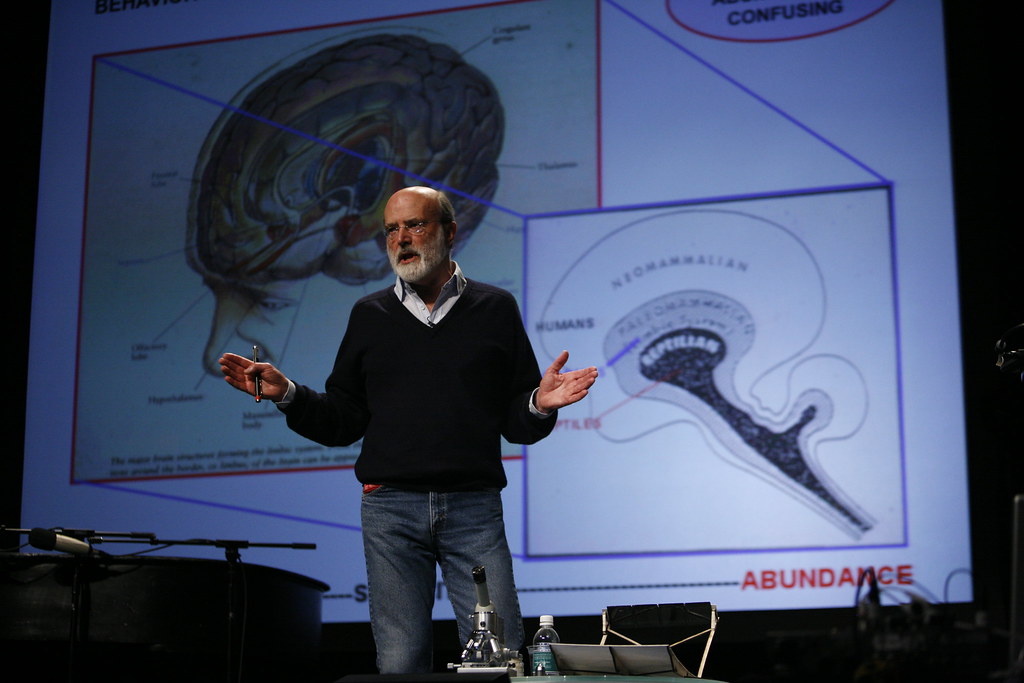
Peter has written a book about what happens to people when we live in a society of abundance and explored the addictive cycle of living with abundance from a physiological perspective. He highlighted the elements that drive humans engagement in our economy: self interest, curiosity, a competition for resources, and social ambition. I can't help but wonder how we balance our innate curiosity-- exploring new ideas and things-- with our need to keep products for 10 years to sustain our ecological health.
Our 24/7, always-on economy surrounds us with stress and a sense of urgency, and creates an environment of low face-to-face people interaction, and it fuels our addiction. It turns otu Starbucks is a part of the vicious cycle. On one slide Peter mentions that Starbucks coffee has 8 times the caffeine in an average cup of coffee. Isn't that crazy? I had always wondered why their coffee made me more jittery.
I was very aware of the negative impacts of this type of life style. Last year's Poptech speaker who talked about the slow movement really helped me re-focus on trying to get more sleep, and increase the amount of face-to-face interaction I had with other people. Studies show that sleep deprivation makes you gain weight because it decreases your ability to control your cravings for high caloric foods. So while Peter didn't provide a 12 step program for breaking the cycle of addiction like I would have hoped, I was re-energized to sleep more, keep up the exercise, increase my face-to-face time with people, and attempt to make my life more simple and less consumer driven. Less stuff, more quality experiences. My family's commitment to having experiences together around Christmas instead of buying each other stuff has always felt "right" but now makes even more sense to me.
One of the themes emerging from Pop!Tech this year, and re-iterated during Peter's presentation was a historical look at the impact that scarcity has on human behavior. In Peter's presentation he looked at the Renaissance - a period of great poverty but also a period of great creativity and innovation. Considering our current economic climate, and considering I'm an optimist, I think I'm going to focus on how scarcity will bring unknown great art and technological innovation.
So his plan to reduce his energy footprint? Massive reduction in travel (Pop!Tech had to work hard to get him to fly to Maine to speak), eliminating his bottle of water per day, becoming a vegetarian, etc. It certainly made me think about reducing my purchases of bottled drinks.
He also advocated for companies to develop products to last longer. I couldn't agree more. Considering I grew up in Maine with a family that made things last, bought things second hand, etc. I can't agree more that we should move away from our disposable culture, learn how to mend clothing, and focus on reducing our "stuff" and keeping our "stuff" longer.
Malcom Gladwell
Malcom is always interesting to listen to. In his presentation, he's taken on the idea that some talents are genetically determined (like the myth that Kenyans are better at running) and has instead looked at the data and discovered that it has everything to do with how young people's talent is nurtured. For instance, boys in Kenyan run 5 to 10 miles per day. Compare that to how inactive American boys are, and you can see why our athletes might not be as good at long distant running. So there isn't a scarcity in talent, we just are not preparing our youth effectively to capitalize on their talents.
Peter Wybrow
Peter has written a book about what happens to people when we live in a society of abundance and explored the addictive cycle of living with abundance from a physiological perspective. He highlighted the elements that drive humans engagement in our economy: self interest, curiosity, a competition for resources, and social ambition. I can't help but wonder how we balance our innate curiosity-- exploring new ideas and things-- with our need to keep products for 10 years to sustain our ecological health.
Our 24/7, always-on economy surrounds us with stress and a sense of urgency, and creates an environment of low face-to-face people interaction, and it fuels our addiction. It turns otu Starbucks is a part of the vicious cycle. On one slide Peter mentions that Starbucks coffee has 8 times the caffeine in an average cup of coffee. Isn't that crazy? I had always wondered why their coffee made me more jittery.
I was very aware of the negative impacts of this type of life style. Last year's Poptech speaker who talked about the slow movement really helped me re-focus on trying to get more sleep, and increase the amount of face-to-face interaction I had with other people. Studies show that sleep deprivation makes you gain weight because it decreases your ability to control your cravings for high caloric foods. So while Peter didn't provide a 12 step program for breaking the cycle of addiction like I would have hoped, I was re-energized to sleep more, keep up the exercise, increase my face-to-face time with people, and attempt to make my life more simple and less consumer driven. Less stuff, more quality experiences. My family's commitment to having experiences together around Christmas instead of buying each other stuff has always felt "right" but now makes even more sense to me.
One of the themes emerging from Pop!Tech this year, and re-iterated during Peter's presentation was a historical look at the impact that scarcity has on human behavior. In Peter's presentation he looked at the Renaissance - a period of great poverty but also a period of great creativity and innovation. Considering our current economic climate, and considering I'm an optimist, I think I'm going to focus on how scarcity will bring unknown great art and technological innovation.
Tuesday, October 21, 2008
It's Almost Time for Pop!Tech
Oh...I can't wait, and Pop!Tech has posted an intro video about Pop!Tech to get me excited about this year's conference. I can't wait to get re-inspired and get my passion for social change and the potential for technology re-charged.
Thursday, October 09, 2008
Selling Lotion through Mapping Social Networks
I found a fascinating article about how Vaseline created a film documentary through mapping the social network of a small town in Kodiak, Alaska, and then analyzed the social network to determine who was the "sneezer" (a reference there to the Ideavirus book)...or the one in the community who was recommending the lotion the most to other town residents.
Once they found Petal Ruch (a voice coach and 40-year-old mother of four) or the "hub" of referrals, they documented their life and how the lotion is a part of their life and launched the documentary about lotion use on the web.
I think it's a fascinating study of a company analyzing social dynamics and one to one referrals to create a marketing campaign that seems real - using video to amplify the message coming from that one sneezer. And as an added bonus, it's unique enough to pick up traditional media coverage in the New York Times....
Once they found Petal Ruch (a voice coach and 40-year-old mother of four) or the "hub" of referrals, they documented their life and how the lotion is a part of their life and launched the documentary about lotion use on the web.
I think it's a fascinating study of a company analyzing social dynamics and one to one referrals to create a marketing campaign that seems real - using video to amplify the message coming from that one sneezer. And as an added bonus, it's unique enough to pick up traditional media coverage in the New York Times....
Monday, September 22, 2008
Rap Video about CERN's Large Hadron Collider!
CERN Rap from Will Barras on Vimeo.
A moment of dorkyness folks. Or, if you've been curious about what the Hadron Collider does, you should watch the video.
Also you can donate your computer's time to help them crunch the data: lhcathome.cern.ch/lhcathome/
Tuesday, September 09, 2008
Latest Scientology News - Going to Court in France
I have a fascination with Scientology - a cult created by L. Ron Hubbard a science fiction writer. It turns out France rightly believes that they are a cult and are letting a woman take them to court over charges that the sect swindled her out of $28,000 for vitamins and classes.
Good for her! It would be great to see Scientology finally convicted of a crime...they've committed so many. More about the story here.
Good for her! It would be great to see Scientology finally convicted of a crime...they've committed so many. More about the story here.
Subscribe to:
Posts (Atom)